Partnership
A sustained piece of work with a school or organisation: scoped together, designed with the people who'll use it, tested in practice and handed over.


Every school runs on systems most people never see: how a wellbeing concern is followed up, how behaviour is recorded, how a plan gets made and checked. I design those systems with schools and organisations, and work alongside the people already doing the work well.
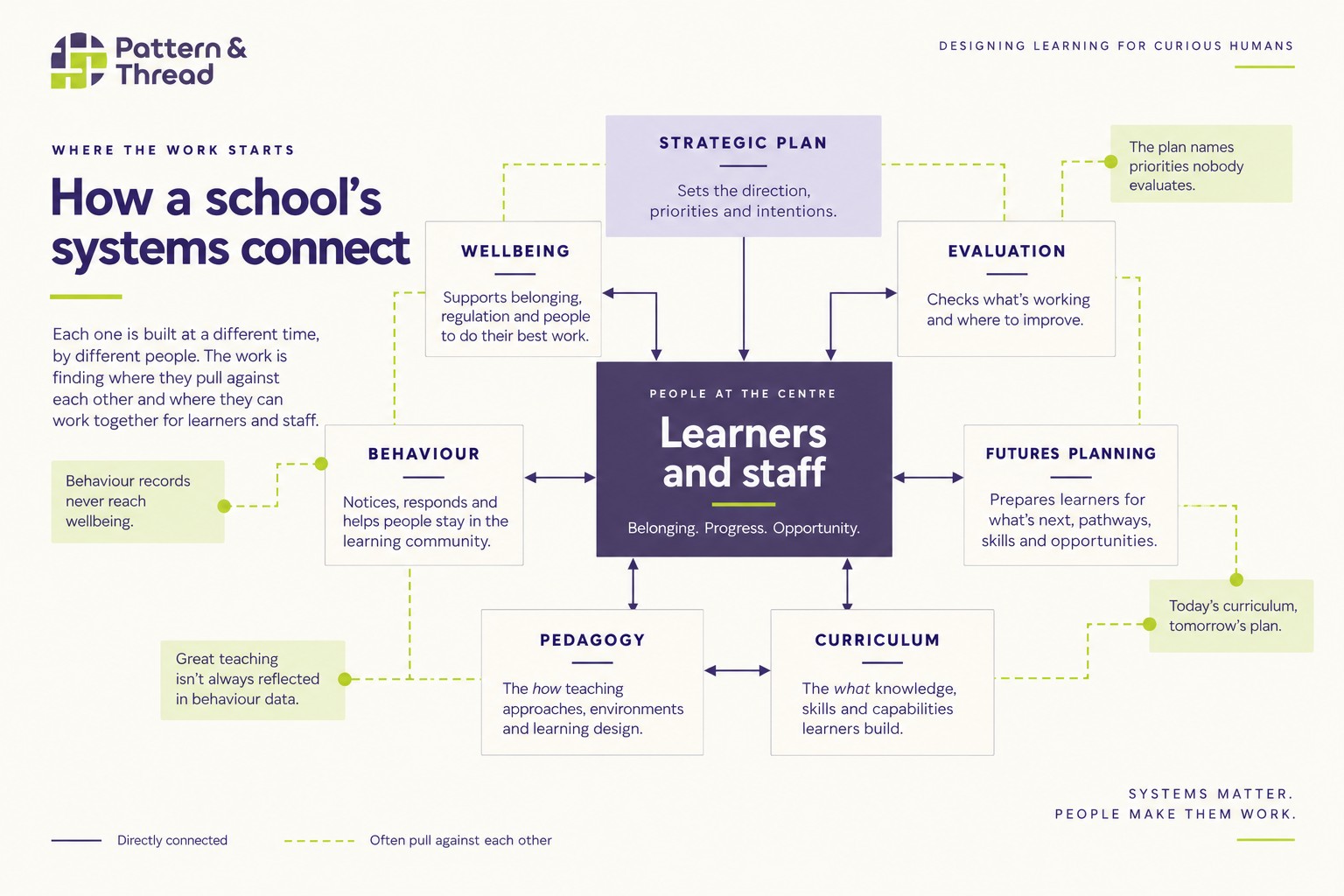
The internal systems a school runs on, and whether they fit the people inside them. Most schools have more of these than anyone has mapped, built at different times by different people, and pulling in slightly different directions.
For people who already do the work and want to get better at it. Peer coaching, professional learning and action learning, blended with design thinking. It isn't a packaged programme. The method has been built over fifteen years of practice, draws on Helen Timperley's Spirals of Inquiry, and is shaped to the team in front of it.
A sustained piece of work with a school or organisation: scoped together, designed with the people who'll use it, tested in practice and handed over.
Bring a difficult problem, a half-built structure or a curriculum that isn't sitting right, and work through it with me for ninety minutes or two hours.
Days and sessions built around your team's real question, with peer coaching to carry the work past the day itself.
Conference sessions, leadership days and facilitated planning. Ask about what you have in mind.
Get in touch →What's happening, what you've already tried, and what would be different if it worked.
A short written plan: the question, the people involved, the timeframe and the cost.
Designed with the people who will use it, tested early, changed when it doesn't fit.
Your people can run it without me, and we check it's doing what it was meant to.
Write with what's happening and what you've already tried. That's enough to start a conversation.