Dashboards
Clear, relevant views of attendance, behaviour, wellbeing, learning growth, assessment and student voice. Separate exports joined into one picture, so the question you actually have can be answered.

I design, build and support data systems that work for your school. From learner data to operational systems, connected so the information is there when a decision needs it.
Better connected information for brighter possibilities.
So the teacher becomes the integration layer, copying, re-keying and stitching exports together by hand. I build the systems that take that job off them.
I've built these systems in schools I've worked in, and I've seen them from the system side too: in the NSW Department of Education's information technology team, and consulting with state education systems and independent schools around Australia. I know what our platforms will and won't connect, and where the structures around them get in the way. That's usually the difference between a dashboard people use every week and one that's quietly abandoned by term two.
I don't arrive with a product or a framework and ask your school to fit it. Every system starts from your school's own questions, your information and your ways of working. The same work runs through my role at Canva, where I design data visualisation systems that support how educational resources are planned and produced at global scale.
A deputy principal suspected behaviour peaked in the period before lunch. Joining behaviour data to the timetable showed something else: the transition back from lunch, in one year level, mostly in corridors.
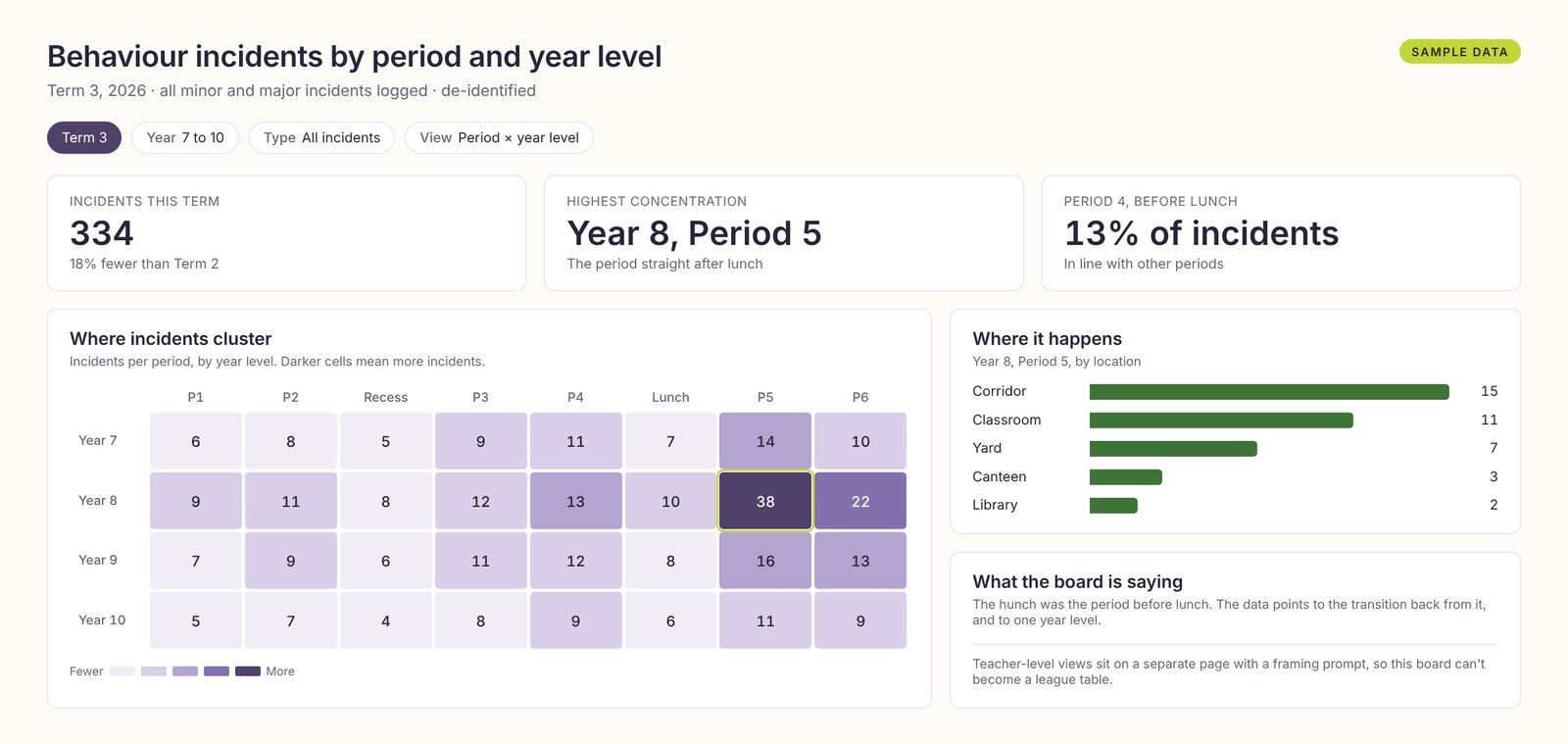
Sample data, built for illustration.
Clear, relevant views of attendance, behaviour, wellbeing, learning growth, assessment and student voice. Separate exports joined into one picture, so the question you actually have can be answered.
Less manual work and more time for what matters. The reports, reminders and re-keying that eat into planning time, done once and done properly.
What gets gathered, by whom, and whether anyone uses it. Collection designed so the information arrives clean and joined up, rather than fixed afterwards.
Bespoke tools for your context: visual learner profiles, printable visuals that sit alongside a school report, and small tools built for one process or one recurring question.
Ongoing technical care and evolution. Schools change every term, and the system changes with them, so what we build keeps working after the first year.
Built for support, not surveillance. Dashboards surface barriers in the environment rather than flagging individual students, and they're designed so they never turn into a staff league table.
Learning profiles, personalised learning plans and individual education plans each do a different job, and most schools are asked to run all three. Built well, they share the same information instead of asking teachers to write it three times.
I've spent more than five years designing, implementing and refining learner profiles in real schools, some of which now sit alongside school reports. That experience shapes every build. It isn't sold as a framework, because no two schools should end up with the same system.
NCCD evidence, registration requirements and reporting obligations are easier to meet when the systems behind them are designed for it, rather than assembled in the weeks before an audit.
We work out where the friction sits, then I design and build the system, put it into your real workflows and keep it running and growing as your school changes.
Start a conversation →Arrive with a prepared dataset, not a day of cleaning spreadsheets, and leave with a working dashboard in your own tools.
See dates →Pre-work on the purpose of your profiles and what you already collect, then a day building a school-specific prototype with a pathway to implementation.
See dates →Short online sessions in small groups, where you leave with one working piece: a visualisation, a dashboard component. Still taking shape.
Tell me you'd come →Tell me, and I'll help you work out whether we can build it.
Write with what's happening and what you've already tried. That's enough to start a conversation.